SUMMARY:
-
Drop-on-demand microdispensing introduces monodisperse droplets into ICP-MS systems, improving sample consistency, sensitivity, and enabling detection of particles as small as ~3 nanometers.
-
Innovations like helium-assisted evaporation and vertical ICP-MS configurations boost transport efficiency and allow multi-element analysis of individual particles and cells, including those up to 20 micrometers.
Background
- Nanoparticles (NPs), like microplastics, are increasingly present in environmental, biological, and industrial contexts. Their characterization is essential due to potential health and ecological risks.
- Traditional ICP-MS techniques struggle with complex matrices, low concentrations, and multi-element detection, especially for single particles or cells.
- Single-particle ICP-TOFMS (sp-ICP-TOFMS) has emerged as a powerful tool for high-throughput, multi-element analysis of individual particles, droplets, and cells.
- Microdispensing forms an essential part of those techniques
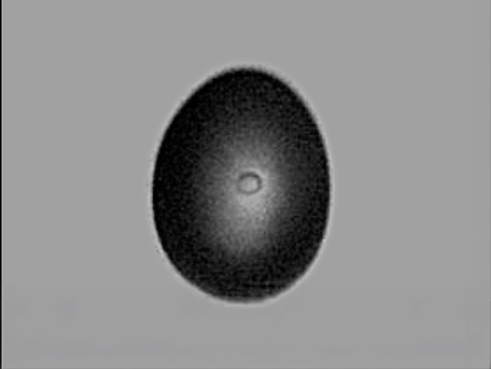
The title image featured here originate from the research of Prof. Günthers group at ETH Zürich. You can explore more about their work on their website.
Reasons for Using Microdispensing
Microdispensing offers several advantages:
-
- Controlled sample introduction: Monodisperse droplets ensure consistent particle delivery and reduce variability.
- Enhanced sensitivity: Droplet-based systems reduce dilution and matrix effects, enabling detection of smaller particles (down to ~3 nm).
- Temporal resolution: Droplets produce transient signals that can be resolved and analyzed individually, revealing vaporization dynamics and elemental separation.
- Cell integrity: In case of biological applications, droplets preserve cell morphology and allow single-cell analysis without fragmentation allowing the study of entire cells
How are can Drop-on-Demand generators be used with Massspectrometry
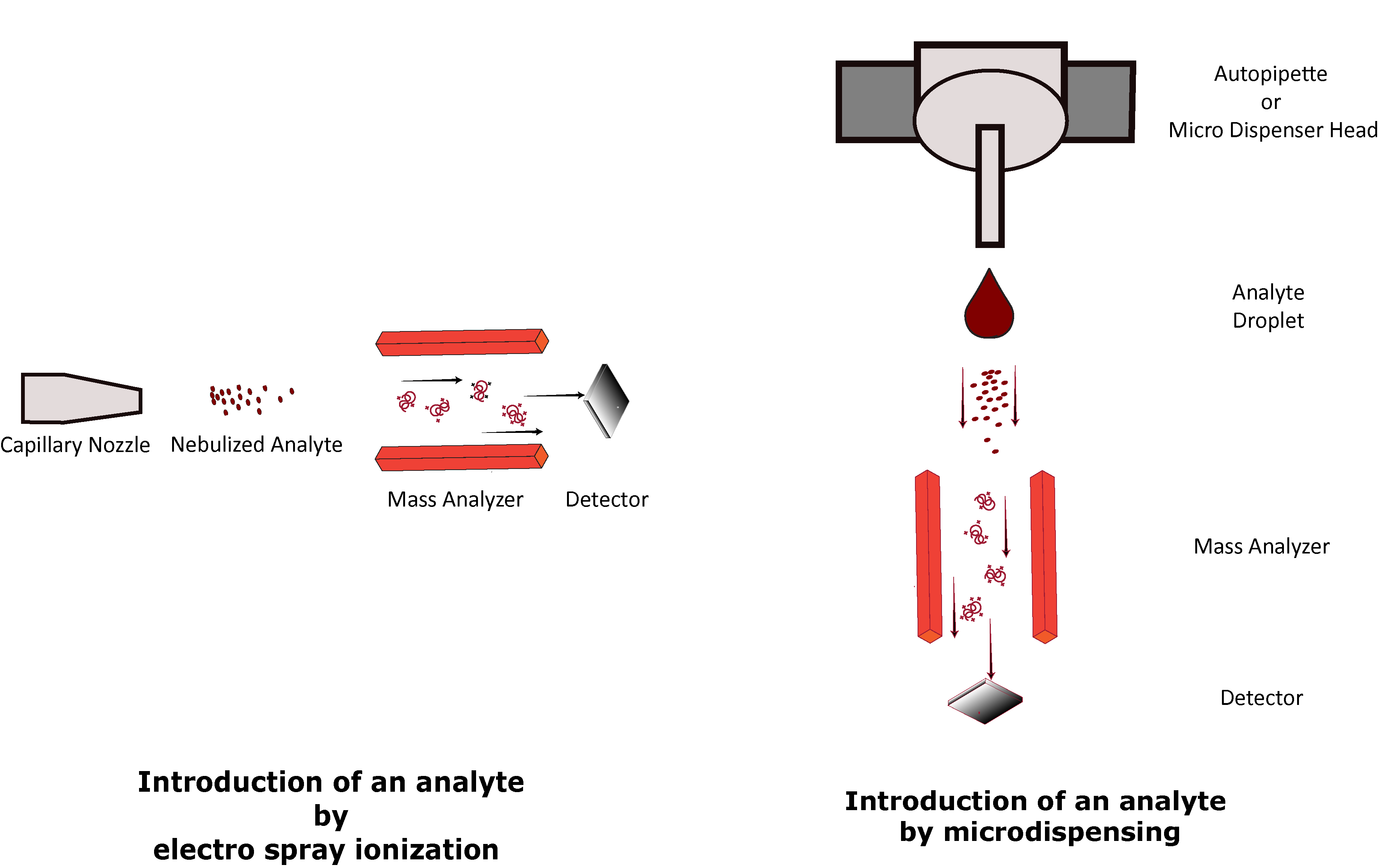
- In traditional methods samples are nebularized by means of a cappilary
- As opposed to tradional sample microdispensing can be used to generate monodisperse droplets. Those dropletss can be used to introduce particles or cells in controlled volumes, improving transport efficiency and signal reproducibility.
- Special adjustments can further improve the setup:
- Helium-assisted evaporation: Accelerates droplet desolvation compared to argon, enhancing detection sensitivity. (link)
- Vertical ICP-MS configurations: Improve mass-independent droplet transport and allow analysis of larger particles (up to 20 µm). (link)
Utility and Outlook
- The integration of microdroplet technology with ICP-TOFMS has revolutionized single-particle and single-cell analysis by improving sensitivity, reproducibility, and multi-element capabilities.
- Overall, these studies demonstrate that droplet-based sp-ICP-TOFMS is a versatile and evolving platform for high-resolution, quantitative analysis of complex particulate systems
References
We are grateful to Prof Günther and his group for allowing us to use their images and using our product in their research. Their website can be found here: https://guenther.ethz.ch/
This technique has revealed important insights in:
- Simultaneous Quantification of Nanoparticles using Microdroplets
- Multi-element detection with spICP-MS
- Quantifying microplatsic paricles with spICP-MS
- Optimizing the design of sp ICP-TOFMS instruments
- Parameters affecting droplet behaviour in ICP-MS
- Analysis of Inorganic Nanoparticles by ICP-MS
- Easier analysis of sp ICP-MS using Poisson distribution
- Impact of plasma composition on the efficiency of spICP-MS
- Introducing droplets at a falling angle improves the detection in spICP-MS (Link and Link)