SUMMARY:
-
Microdispensing Enables Real-Time Calibration in ICP-MS: Monodisperse microdroplets serve as precise, matrix-independent standards for nanoparticle quantification, bypassing the limitations of conventional nebulization and certified reference materials.
-
Dual Introduction Enhances Signal Accuracy: A dual inlet system combines nebulization with microdroplet generation. Using advanced algorithms, this approach can correct for signal artifacts- resulting in near 100% plasma delivery and reliable particle sizing.
-
Scalable, Multi-Element Analysis for Complex Media: The technique supports simultaneous multi-element detection in challenging matrices like wastewater and PBS, paving the way for high-throughput environmental monitoring and field-deployable systems.
Background
- Nanoparticle Analysis Needs Precision: With growing interest in nanomaterials across medicine, environmental science, and materials engineering, accurate quantification of nanoparticle size, mass, and concentration is critical.
- Limitations of Traditional Methods: Techniques like SEM, TEM, and SIMS offer structural insights but fall short in quantitative analysis. Conventional ICP-MS struggles with matrix effects and lacks reliable nanoparticle standards.
The particle images featured here originate from the research of Prof. Günther's group at ETH Zürich. Visit their page here.
Reasons for Using Microdispensing
Microdispensing offers several advantages:
- High Transport Efficiency: Near 100% delivery of droplets into the plasma, compared to ~10% with pneumatic nebulization.
- Matrix Independence: Calibration compensates for plasma and matrix effects, enabling accurate measurements in complex media (e.g., PBS, wastewater).
- Real-Time Sensitivity Tracking: Continuous calibration corrects for instrumental drift and variability.
- Multi-Element Capability: Enables simultaneous quantification of multiple elements per particle, useful for identifying engineered or environmental nanoparticle fingerprints.
- Enhanced Accuracy: Better recovery rates and lower detection limits for nanoparticles, especially in environmental and biomedical applications.
How are can microdispensing can be used to introduce standarts into Massspectrometry
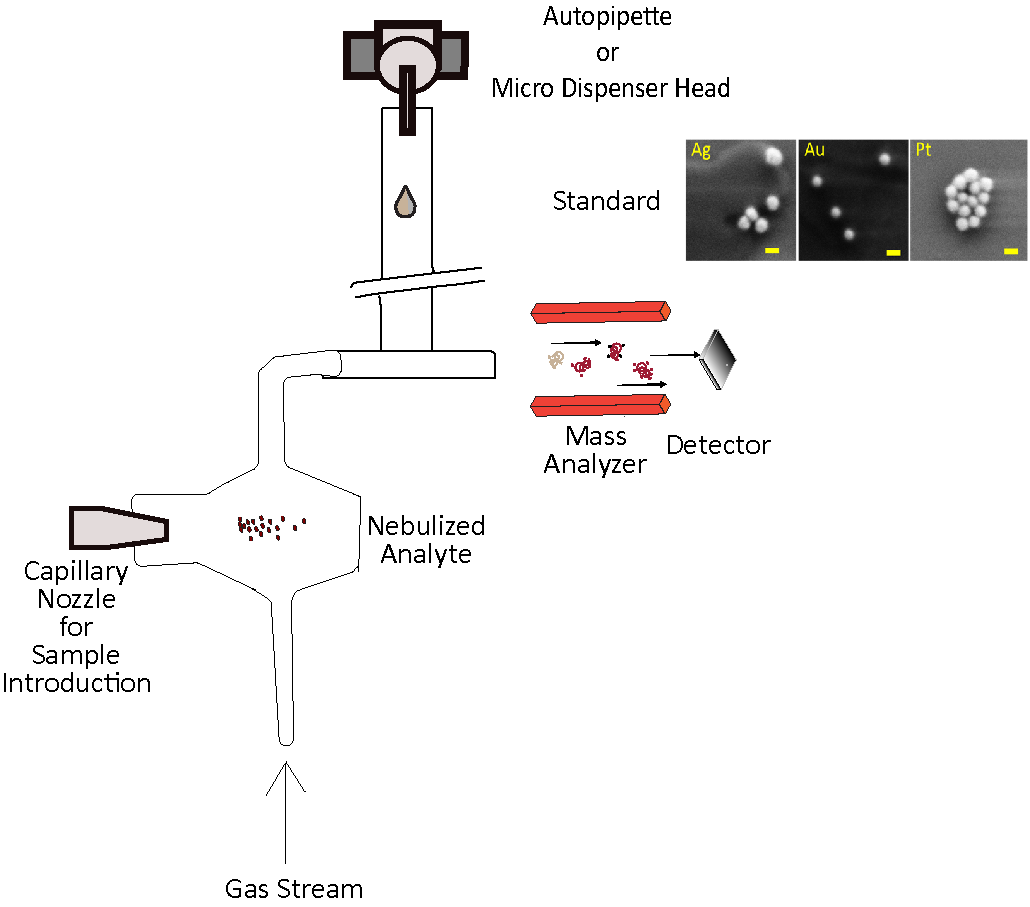
- Microdroplet Generation (MDG): A microdroplet generator produces uniform droplets (typically 30–40 µm) containing known concentrations of calibration elements.
- Dual Introduction System: These droplets are introduced alongside the sample stream into the ICP-MS, often via a dual inlet system combining nebulization and microdispensing.
- Online Calibration: Droplets act as real-time standards, enabling calculation of detection efficiencies and plasma uptake rates. This allows accurate quantification of nanoparticle signals without external reference materials.
- Signal Processing: Advanced algorithms correct for split events, background noise, and coincident particle artifacts, ensuring reliable particle detection and sizing.
Utility and Outlook
Microdispensing bridges the gap between fundamental research and real-world applications.It is poised to revolutionize nanoparticle analysis in ICP-MS by offering a flexible, accurate, and scalable calibration method.
References
We are grateful to Prof Günther and his group for allowing us to use their images and using our product in their research. Their website can be found here: https://guenther.ethz.ch/
This technique has revealed important insights in:
- Capabilities of inductively coupled plasma mass spectrometry for the detection of nanoparticles carried by monodisperse microdroplets
- Single-particle ICP-MS with online microdroplet calibration: toward matrix independent nanoparticle sizing
- Comparison of sp-ICP-MS and MDG-ICP-MS for the determination of particle number concentration
- A method for the preservation and determination of welding fume nanoparticles in exhaled breath condensate
- Monte Carlo Simulation of Low-Count Signals in Time-of-Flight Mass Spectrometry and Its Application to Single-Particle Detection
- Quantification and Clustering of Inorganic Nanoparticles in Wastewater Treatment Plants across Switzerland
- Monodisperse microdroplets: a tool that advances single-particle ICP-MS measurements
- Emerging Investigator Series: Automated Single-Nanoparticle Quantification and Classification — A Holistic Study of Particles Into and Out of Wastewater Treatment Plants in Switzerland
- Detection of magnetic iron nanoparticles by single-particle ICP-TOFMS: case study for a magnetic filtration medical device